SEARCH
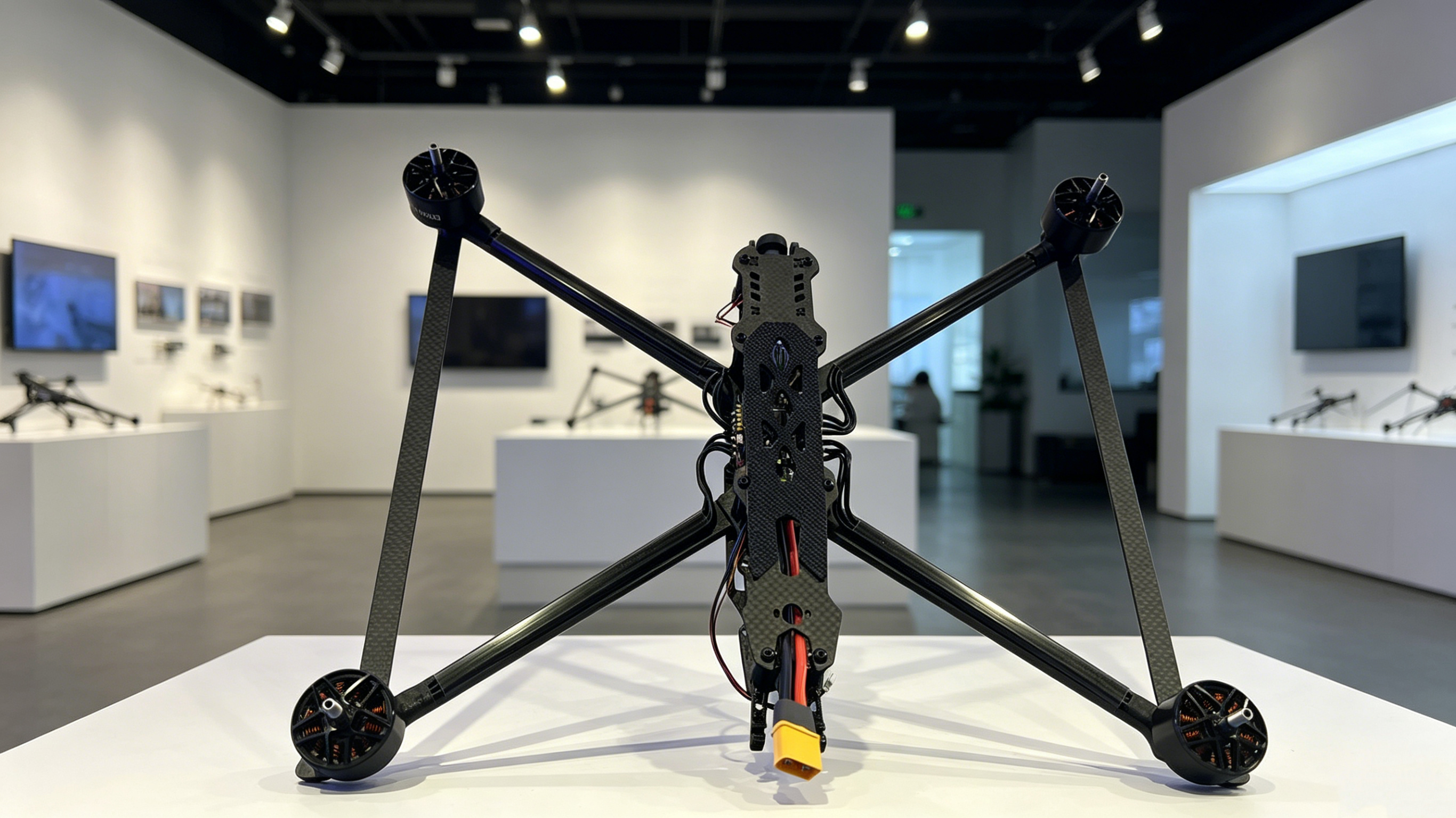
The project involved the development of a 7-inch FPV quadcopter designed for a combination of high-speed flight, long-range cruising and lightweight payload applications. Compared with conventional 5-inch FPV drones, a 7-inch platform provides greater propeller area and more space for batteries and equipment, but the increased aircraft size and takeoff weight also place higher demands on the propulsion system.
The customer required a motor that could provide strong thrust without significantly increasing the overall weight of the aircraft. The motor also needed to respond quickly to throttle changes and maintain stable operation during repeated acceleration, climbing and high-load flight.
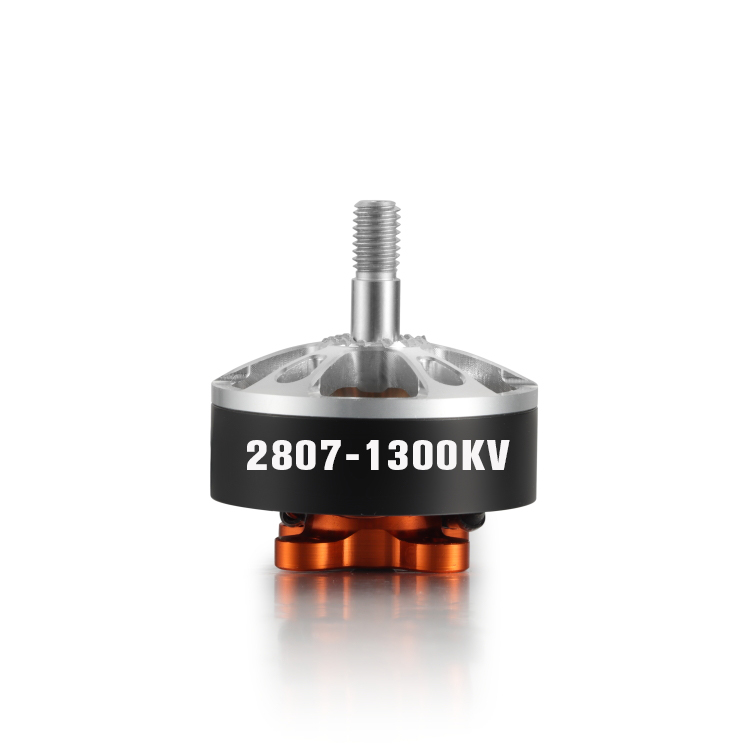
Based on these requirements, BGS selected the F2807 external rotor motor, featuring a compact approximately 32.94 × 34.05 mm motor size, 52.6g weight, 5mm shaft and 12N14P configuration. The motor supports a 4–6S LiPo battery platform, with the product specification listing a recommended 22.2V battery and a maximum thrust reference of 2.17kg. The product is designed around 7–7.5-inch UAV platforms and is compatible with larger 7-inch-class propellers.
This combination provides a useful balance between motor weight, torque, thrust and installation space, making the F2807 suitable for high-performance 7-inch FPV platforms.
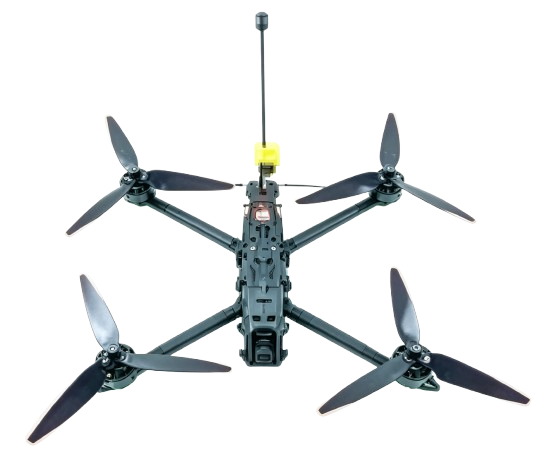
The main challenge was not simply to increase maximum thrust, but to achieve a suitable thrust-to-weight ratio while maintaining responsive flight characteristics and reliable thermal performance.
A 7-inch FPV drone carrying a large-capacity battery, camera system or other equipment can become significantly heavier than a conventional racing drone. The propulsion system therefore needs sufficient thrust reserve for takeoff, rapid acceleration, climbing and emergency recovery.
During BGS testing, the F2807 with a 6S battery and 7035-3 propeller produced approximately 2,210g of thrust at 38.2A and 826.65W in the 1300KV configuration. The 1500KV configuration reached approximately 2,490g thrust at 55.5A and 1,160.51W under the listed test conditions.
These figures provide engineers with a useful reference when selecting the final motor KV, propeller and ESC combination.
Increasing motor size can provide more torque, but it also increases the weight of every propulsion unit. For a quadcopter using four motors, even a small increase in motor weight is multiplied across the entire propulsion system.
The F2807 maintains a compact approximately 33mm-class motor diameter, while the listed motor weight is only 52.6g for the recommended configuration. Its M5 propeller adapter and Φ19-M3-4 mounting arrangement also make it suitable for compact 7-inch UAV structures.
High-throttle operation generates greater current and heat, while rotor imbalance can introduce vibration into the aircraft. This is particularly important for FPV drones carrying cameras because excessive vibration can affect flight stability and image quality.
The F2807 uses a 12N14P external rotor configuration and is specified with dynamic balancing ≤5mg, while the product page also specifies high-temperature copper winding and a self-cooling external rotor structure for demanding operating conditions
To solve these problems, BGS configured the F2807 external rotor brushless motor around the customer's 7-inch FPV propulsion requirements, focusing on four aspects: motor size, KV selection, propeller matching and thermal performance.
The compact external rotor structure provides a high torque output within a relatively small package, while the 12N14P electromagnetic configuration helps deliver responsive throttle control for rapid changes in propulsion demand. For 7-inch applications, different KV options can be selected according to whether the priority is high-speed response, heavy-load thrust or longer-range efficiency.
For example, BGS testing with a F2807 1300KV + 7035-3 propeller + 6S battery achieved approximately 870g thrust at 40% throttle, 1,295g at 60% throttle, 1,871g at 80% throttle, and 2,210g at full throttle. The corresponding power increased from approximately 221W to 827W, demonstrating the motor's ability to provide a broad thrust range rather than only high peak output.
For customers prioritizing higher output, the tested 1500KV configuration reached approximately 2,490g maximum thrust with a 7040-3 propeller under the listed test conditions. Meanwhile, the 1750KV version provides another option for 4S-based configurations, reaching approximately 2,220g thrust with a 7040-3 propeller.
This means the F2807 can be configured according to the aircraft's actual mission rather than using one fixed motor specification for every 7-inch drone. For long-range FPV applications, a lower-KV configuration can emphasize efficiency, while higher-KV versions can provide stronger acceleration and more aggressive flight response.
Beyond the motor itself, BGS also provides motor, propeller, battery and ESC matching support. This is important because the final thrust and efficiency of a UAV propulsion system depend on the interaction between all four components rather than the motor alone.
The resulting solution is suitable for 7-inch FPV freestyle and racing drones, long-range FPV cruisers, cinematic platforms carrying lightweight cameras, mapping and inspection drones, and other compact UAV applications.
For a professional UAV project, motor delivery is only the beginning of the engineering process. After the customer receives the F2807 motors, BGS provides technical support to help the customer complete propulsion-system integration and performance validation.
During the initial stage, BGS can assist with KV selection, propeller matching, battery voltage and ESC selection according to the aircraft's total weight, target payload, desired flight time and required thrust. This helps prevent common problems such as excessive current, insufficient thrust or motor overheating caused by an unsuitable propulsion combination.
During flight testing, BGS can also support troubleshooting for abnormal vibration, excessive motor temperature, insufficient thrust, unusual bearing noise and unstable throttle response. Because the F2807 is designed with precision dynamic balancing, high-temperature copper winding and a compact external rotor structure, the motor provides a stable hardware foundation for continuous UAV testing.
For customers with different frame dimensions or performance targets, BGS can further provide OEM and ODM customization, including motor size and performance parameters. The company states that it provides customized motor solutions, rapid technical response, fast delivery and a one-year quality assurance service.
The goal is therefore not simply to supply a standard 2807 motor, but to help customers complete the entire propulsion development process—from motor selection and parameter matching to prototype testing, troubleshooting and final production.
 BACK
BACK


BG Motor insisting on producing the best quality motors for our customers.