SEARCH
As smart factories, automated warehouses, and intelligent logistics systems continue to expand worldwide, Automated Guided Vehicles (AGVs) have evolved far beyond simple material transport equipment. Modern AGVs are expected to navigate complex environments autonomously, transport heavy payloads efficiently, operate continuously for long periods, and maintain precise positioning accuracy throughout their service life. These increasing performance requirements place enormous pressure on the drive system, making motor selection one of the most critical decisions in AGV design.
Among various drive solutions, high-torque DC brushless motors have become the preferred choice for many AGV manufacturers. Their combination of efficiency, reliability, precise speed control, and long service life makes them particularly suitable for modern industrial automation environments. More importantly, as AGVs become smarter and more autonomous, motor systems are no longer viewed as simple power sources but as essential components that directly influence productivity, energy efficiency, maintenance costs, and overall operational stability.
Unlike conventional industrial equipment that operates from a fixed location, AGVs must continuously move, accelerate, decelerate, turn, and stop while carrying varying payloads. This dynamic operating environment creates several unique challenges for the motor system.
One of the most important requirements is high starting torque. AGVs often transport heavy materials, pallets, components, or finished products weighing hundreds of kilograms. When starting from a stationary position, the drive system must overcome both the inertia of the vehicle and the resistance created by the payload. A motor with insufficient torque can lead to sluggish acceleration, excessive current consumption, and reduced operational efficiency.
At the same time, AGVs require precise speed control and positioning accuracy. Whether approaching a charging station, docking at a workstation, or coordinating with robotic arms and automated storage systems, even small positioning errors can disrupt an entire automated workflow. This places greater demands on the responsiveness and controllability of the motor system.
Continuous operation presents another challenge. Many logistics centers and manufacturing facilities operate around the clock, requiring AGVs to function for extended periods with minimal downtime. Under these conditions, motor efficiency, thermal management, and reliability become essential factors affecting long-term performance.
To meet these demanding requirements, more AGV manufacturers are adopting high-torque DC brushless motors instead of traditional brushed motors.
The absence of mechanical brushes significantly reduces friction and wear inside the motor, resulting in a longer operational lifespan and lower maintenance requirements. This advantage is particularly valuable in automated facilities where minimizing downtime is critical for maintaining productivity.
In addition, DC brushless motors deliver exceptionally high efficiency. Compared with conventional motor technologies, they convert a greater percentage of electrical energy into useful mechanical output, reducing energy losses and extending battery operating time. For battery-powered AGVs, improved efficiency directly translates into longer working hours and fewer charging interruptions.
Perhaps the most important advantage is their ability to generate substantial torque when combined with a precision reduction gearbox. Through optimized gear reduction ratios, the motor's rotational speed is converted into powerful output torque, enabling AGVs to move heavy loads smoothly while maintaining excellent speed control. This combination of high torque and precise motion control allows AGVs to operate safely and efficiently in demanding industrial environments.
While AGVs benefit greatly from high-torque brushless motor systems, continuous-duty operation introduces several engineering challenges that must be carefully addressed.
Heat generation remains one of the most significant concerns for AGV drive systems. During prolonged operation, electrical losses, magnetic losses, and mechanical friction continuously generate heat within the motor and gearbox. If not properly managed, excessive temperatures can reduce efficiency, accelerate component aging, and ultimately shorten system lifespan.
Modern brushless motor designs address this issue through high-efficiency magnetic circuits, optimized winding configurations, and advanced thermal management structures. Aluminum housings, improved airflow pathways, and temperature monitoring systems help maintain stable operating temperatures even under heavy workloads.
For AGV manufacturers, selecting a motor with excellent thermal performance is crucial because consistent temperature control directly affects reliability and long-term operational stability.
As AGVs are increasingly deployed in warehouses, hospitals, laboratories, and commercial facilities, noise reduction has become an important consideration.
Excessive noise is often generated by gearbox operation, motor vibration, and mechanical resonance. Advanced brushless motor systems minimize these issues through precision-balanced rotors, high-quality bearings, and optimized electromagnetic designs. When paired with carefully engineered gear reduction systems, the result is smoother operation, lower vibration levels, and a quieter working environment.
Reduced vibration also contributes to improved positioning accuracy and better protection for sensitive cargo being transported throughout the facility.
Modern AGVs rely heavily on accurate speed regulation and motion control. Unlike traditional transport equipment, AGVs must continuously adjust their speed according to navigation conditions, traffic management systems, and obstacle avoidance requirements.
Brushless DC motors excel in this area because they can be integrated with advanced electronic controllers and encoder feedback systems. Through closed-loop control, the motor controller continuously monitors speed and position data, making real-time adjustments to ensure smooth and accurate movement.
This capability enables AGVs to perform delicate positioning tasks, navigate narrow warehouse aisles, and coordinate seamlessly with other automated systems. As warehouse automation becomes increasingly sophisticated, precise motor control is becoming just as important as raw torque output.
Heavy-load transportation remains one of the most demanding AGV applications. Industrial AGVs frequently move large pallets, manufacturing equipment, raw materials, and finished products across production facilities and logistics centers.
High-torque brushless motors provide the necessary power density to handle these tasks effectively. By combining efficient electromagnetic design with optimized reduction gearing, the drive system can deliver substantial output torque while maintaining compact dimensions.
This allows AGV manufacturers to design vehicles that carry heavier payloads without significantly increasing vehicle size or battery consumption. The result is a more productive and efficient transportation platform capable of meeting the growing demands of modern industrial automation.
The role of motor systems in AGVs continues to expand as Industry 4.0 technologies become more widespread. Today's advanced brushless motor systems are increasingly integrated with intelligent control platforms capable of monitoring temperature, current consumption, operating status, and performance trends in real time.
This data can be used for predictive maintenance, allowing operators to identify potential issues before they lead to unexpected failures. By reducing unplanned downtime and improving maintenance scheduling, intelligent motor systems help maximize fleet availability and operational efficiency.
Furthermore, the combination of high efficiency, low maintenance requirements, precise control, and intelligent monitoring positions brushless DC motors as a key enabling technology for the next generation of autonomous mobile robots and smart logistics solutions.
Selecting the right motor is one of the most important decisions when designing an AGV. Payload capacity, driving speed, duty cycle, battery voltage, and operating environment all directly influence motor selection. To meet these diverse requirements, BG Motor offers high-torque brushless geared motors specifically engineered for AGV, AMR, and intelligent logistics platforms.
For warehouse AGVs, pallet movers, and industrial transport robots, the BG130BLDC Series delivers a powerful combination of torque, efficiency, and long-term reliability. Designed specifically for heavy-duty traction applications, this motor provides stable low-speed operation and strong starting torque, allowing AGVs to accelerate smoothly even under significant payload conditions.
Key Specifications: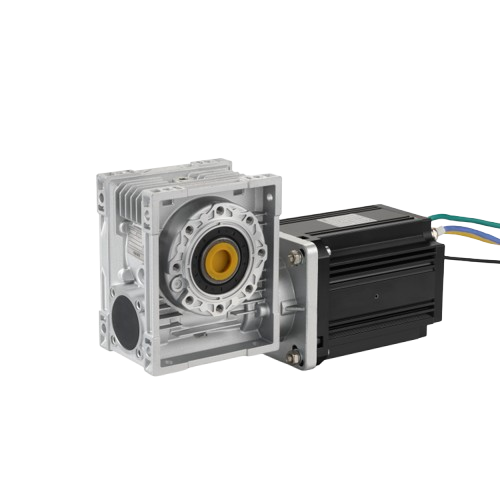
Voltage Range:48VDC – 310VDC
Power Range:1000W – 3000W
Rated Speed:30 – 400 RPM
Rated Torque:100 – 300 N·m
Noise Level:≤65 dB
Protection Class:IP40 – IP65
Duty Cycle:S1 / S2 / S3
Lifespan:5,000 – 20,000 Hours
The motor utilizes a high-efficiency brushless drive system combined with a heavy-duty worm gearbox. This configuration not only increases output torque but also provides self-locking capability, helping AGVs maintain position safely during stopping or slope operation.
While heavy-duty AGVs prioritize maximum traction and payload capacity, many modern mobile robots focus on navigation accuracy, flexible movement, and energy efficiency. For these applications, the BG110BL134 brushless geared motor offers an excellent balance between torque output, compact dimensions, and precise motion control.
Designed around a NEMA42 brushless platform, this motor can be integrated with planetary or helical gearboxes, providing smooth acceleration, accurate positioning, and reliable continuous-duty operation. It is particularly suitable for autonomous mobile robots (AMRs), hospital delivery robots, inspection robots, service robots, and light-duty warehouse AGVs.
Key Specifications: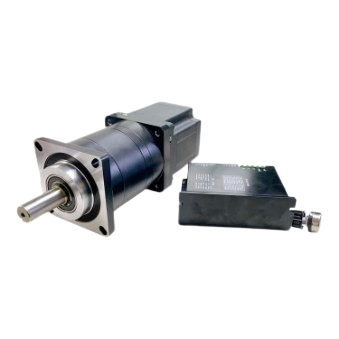
Motor Type:Three-Phase Brushless DC Motor
Frame Size:NEMA42 / 110 mm
Voltage Range:12VDC – 310VDC
Power Range:400W – 2000W
Rated Speed:1500 – 4000 RPM
Rated Torque:1.27 – 6.37 N·m
Protection Class:IP40
Noise Level:≤60 dB
Duty Cycle:S1 / S2 / S3
Lifespan:5,000 – 20,000 Hours
The success of modern AGV robots depends heavily on the performance of their drive systems. As automation applications demand greater payload capacity, longer operating hours, higher positioning accuracy, and improved reliability, traditional motor technologies are increasingly being replaced by high-torque DC brushless motor solutions.
By delivering outstanding efficiency, precise speed control, smooth operation, low maintenance requirements, and powerful torque output, brushless DC geared motors provide the ideal foundation for intelligent AGV systems. At the same time, advanced thermal management, vibration reduction, and smart monitoring technologies ensure these motors can meet the rigorous demands of continuous industrial operation.
As warehouses, factories, and logistics networks continue their transformation toward full automation, high-torque brushless DC motor systems will remain one of the most important technologies driving the future of AGV performance, efficiency, and reliability.
 BACK
BACK
As a “barometer” of China's foreign trade, the 139th Canton Fair (April 2026…
The 2nd Advanced Motor Materials Innovation Forum has officially opened, as indu…
Global Electric Motor Industry UpdateRecently, the global electric motor industr…
BG Motor Resumes Full Production – February 24, 2026BG Motor has officially resu…
Chinese New Year Holiday Notice (2026)Dear Valued Customers and Partners,To cele…
With the continuous upgrading of global manufacturing, the rapid growth of new e…