SEARCH
Swimming pool cleaning robots are designed to operate in a challenging environment where water resistance, continuous operation, debris collection, and reliable movement all influence overall performance. Unlike conventional household cleaning appliances, pool cleaning robots must move across wet surfaces, climb walls, remove dirt from different areas, and maintain effective water circulation while operating underwater.
Behind these functions is a coordinated motor system. Depending on the robot's design, it may include independent drive motors, brush motors, suction motors, and water pump motors. Each motor performs a different task, meaning that selecting the right motor requires more than simply comparing rated power or rotational speed.
For motor manufacturers and equipment designers, the key is to match motor characteristics with the mechanical structure, operating environment, and workload of each subsystem.
This article explores the main motor applications in swimming pool cleaning robots, explains their technical requirements, and introduces suitable motor solutions from BG Motor.
A typical robotic pool cleaner uses several motor-driven systems to complete its cleaning tasks. Although the exact configuration varies between cordless, corded, and commercial models, the main motor applications generally include:
Motor system | Main function | Key motor requirement |
|---|---|---|
Drive motor | Moves the robot across the pool floor and walls | High torque, low speed, stable operation |
Brush motor | Rotates brushes to remove attached dirt and algae | Stable torque, appropriate speed |
Suction motor | Drives an impeller to create water flow and collect debris | High speed, efficient operation |
Water pump motor | Circulates water through the filtration system | Stable flow, continuous-duty capability |
Some compact designs combine brushing and movement into a shared transmission system, while others use independent motors to provide more precise control.
It is also important to distinguish between a suction motor and a water pump motor. In many pool cleaners, the same motor-driven impeller generates the water flow responsible for suction and filtration. In other designs, separate pumping and suction assemblies are used to achieve different hydraulic functions.
The motor configuration should therefore be determined by the actual water-flow architecture rather than assuming that every pool cleaner requires four independent motors.
The drive motor is responsible for moving the pool cleaning robot across the bottom, along the walls, and sometimes around steps or curved surfaces. Unlike a robot operating on a dry floor, an underwater cleaner must overcome water resistance, friction, changes in surface adhesion, and additional mechanical resistance when climbing.
A drive motor must deliver sufficient starting torque and maintain stable output even when the robot encounters different surface conditions.
Pool cleaning robots generally do not need extremely high travel speeds. Instead, they require controlled movement and sufficient torque to maintain traction.
Several factors influence the required drive motor torque:
Robot weight: The total weight of the cleaner, including its housing, battery, filtration system, and internal components, affects the load on the drive system.
Water resistance: Although water reduces the apparent weight of the robot, it also introduces drag during movement.
Wall climbing: When moving vertically, the drive system must overcome the effects of gravity and maintain sufficient contact force.
Track and wheel resistance: Tracks, transmission gears, and rotating components introduce additional mechanical losses.
Operating conditions: Debris accumulation, surface texture, and changing traction conditions can increase the required output torque.
For this reason, a high-speed motor without sufficient torque is not necessarily a good solution.
A geared DC motor is a practical choice for the drive system because it combines a relatively high-speed motor with a reduction gearbox to produce lower output speed and higher torque.
Two common configurations are:
Planetary Gear Motors
Planetary gearboxes offer a compact structure, relatively high transmission efficiency, and good torque density. They are suitable for pool cleaners with limited installation space and higher movement or climbing requirements.
Worm Gear Motors
Worm gearboxes provide substantial speed reduction and high output torque in a compact arrangement. Depending on the gearbox design, they can also provide resistance to reverse driving, which may help maintain the position of certain drive mechanisms.
However, self-locking should never be assumed without checking the gearbox's actual design and operating conditions.
BG52ZYT02 Planetary Geared Motor
Power: 20–60 W
Voltage: 12–48 VDC
Rated speed range: 3–730 rpm
Rated torque range: 0.38–8 N·m
Its compact planetary gearbox and adjustable output specifications make it a potential option for small and medium-sized pool cleaner drive mechanisms.
Product reference: BG Motor planetary gear motor range.
BG63 Worm Geared Motor
Power: 45–100 W
Voltage: 12–48 VDC
Rated speed range: 45–120 rpm
Rated torque range: 2–6 N·m
This motor is worth considering for drive mechanisms requiring relatively low output speed and higher torque, particularly where a compact worm gearbox is preferred.
Product reference: BG Motor geared motor series.
The final selection should be based on the required output torque, wheel or track diameter, transmission ratio, climbing angle, and continuous operating time.
The brush system is responsible for physically loosening dirt, algae, sand, and other deposits attached to the pool floor and walls. While the suction system collects loose debris, the brush mechanism helps remove contaminants that cannot be easily lifted by water flow alone.
Depending on the design, pool cleaners may use one or two rotating brushes, cylindrical rollers, or specialized brush assemblies.
The brush motor operates under variable mechanical resistance. When the brushes contact a relatively clean surface, the required torque may be low. However, when they encounter stubborn deposits, rough tiles, or accumulated debris, the motor must provide additional torque to prevent the brush from slowing down or stopping.
The main selection considerations include:
Stable output torque: Maintains consistent brush rotation when cleaning resistance changes.
Appropriate rotational speed: Provides effective scrubbing without causing excessive splashing, wear, or unnecessary power consumption.
Overload protection: Prevents motor damage when brushes become blocked by hair, leaves, or other debris.
Compact dimensions: Allows the motor and gearbox to fit inside the robot's limited housing.
Noise and vibration control: Improves the operating experience and reduces mechanical wear.
A low-voltage DC geared motor is generally suitable for brush-drive applications. A planetary gearbox is particularly useful when the design requires compact dimensions and relatively high torque, while a worm gearbox may be considered when a different transmission layout or lower output speed is required.
BG Motor's BG52ZYT02 planetary geared motor and BG63 worm geared motor can both serve as starting points for brush-drive development. The final choice depends on brush diameter, contact pressure, transmission structure, and required rotational speed.
One important design consideration is that the brush motor and travel motor do not necessarily need identical specifications. The drive motor prioritizes vehicle movement and climbing capability, whereas the brush motor focuses on maintaining sufficient scrubbing force under changing contact resistance.
The suction system is one of the most important components of a robotic pool cleaner. It draws water and suspended debris through the intake opening, directs them into the filtration chamber, and returns filtered water to the pool.
Unlike the drive system, which converts electrical energy into mechanical movement, the suction system converts motor power into hydraulic performance.
The motor usually drives an impeller or centrifugal fan-like assembly, generating the pressure difference needed to move water through the filtration pathway.
The basic operating process is straightforward:
The motor rotates the impeller at a controlled speed.
The rotating impeller accelerates water and creates a pressure difference.
Water and debris enter through the suction inlet.
The filtration basket or filter captures leaves, sand, hair, and other particles.
Filtered water passes through the outlet and returns to the swimming pool.
The effectiveness of the suction system depends on more than motor power. Impeller geometry, inlet design, filter resistance, water passage dimensions, and hydraulic losses all influence the final performance.
High-speed operation and hydraulic efficiency
The motor must provide sufficient rotational speed to drive the impeller and generate the required water flow. However, increasing RPM does not automatically increase useful suction performance. An unsuitable impeller or restricted water passage may increase energy consumption without delivering a proportional improvement in flow.
Continuous-duty capability
Pool cleaners may operate for extended cleaning cycles. The motor must therefore maintain stable performance while managing heat generated by electrical losses and mechanical friction.
Waterproof protection
Water exposure is one of the biggest challenges in pool cleaner design. The motor assembly must be protected against water ingress, condensation, and corrosion. Depending on the architecture, the motor may be installed in a sealed dry compartment or use a purpose-designed waterproof construction.
Debris resistance
Hair, leaves, small stones, and other debris can obstruct the impeller or restrict the water passage. A suitable mechanical design should reduce the risk of blockage and allow convenient maintenance.
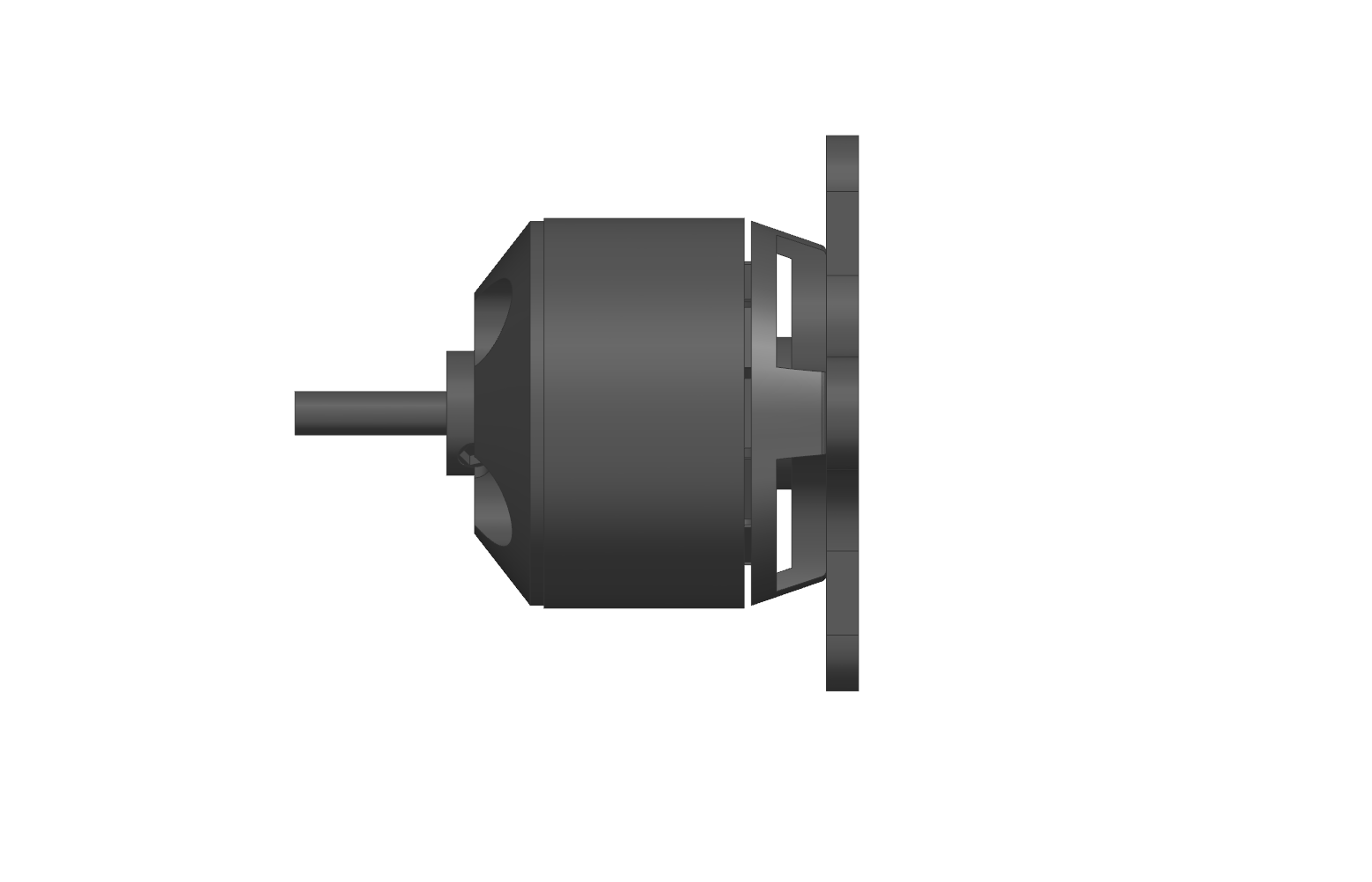
Frame size: 42 mm
Power: 25–105 W
Voltage: 12–48 VDC
Rated speed: 1,500–6,000 rpm
Rated torque: 0.06–0.33 N·m
This compact three-phase BLDC motor is a potential candidate for smaller suction assemblies and water-circulation mechanisms where controlled speed and compact installation are important.
Product reference: BG42BL40 product listing.
A brushless DC motor is particularly attractive for this application because it eliminates mechanical brushes and commutators, reducing one source of wear and maintenance. Its speed can also be adjusted through a compatible electronic controller to match different cleaning conditions and hydraulic requirements.
However, the BG42BL40 is a motor reference rather than a complete waterproof suction assembly. Its suitability depends on the selected impeller, motor protection structure, controller, and actual operating point.
Water pumps are closely related to suction systems, but their engineering requirements can differ depending on the cleaning robot's design.
Some pool cleaners use a single motor-driven impeller to generate suction and circulate water through the filter. Other systems use a separate pump motor to provide additional circulation, filtration, or water movement.
The purpose of the pump is not simply to move water as quickly as possible. It must provide an appropriate balance between flow rate, pressure, efficiency, and energy consumption.
When selecting a pump motor, engineers should pay attention to two major hydraulic parameters.
Flow Rate (Q)
Flow rate indicates the volume of water that the pump can move within a specific period, usually measured in litres per minute (L/min) or cubic metres per hour (m³/h).
A higher flow rate can improve the circulation of water through the filtration system, provided that the filter and water passages can accommodate it.
Head or Pressure (H)
Pump head describes the energy supplied to the water per unit weight, commonly expressed in metres. It represents the pump's ability to overcome resistance in the hydraulic system.
The required head depends on factors such as:
Filter resistance and accumulated debris.
Pipe diameter and water passage design.
Impeller structure and pump housing.
Water inlet and outlet configuration.
A motor with a higher rated power does not automatically guarantee a higher water flow rate or greater pump head. The pump's hydraulic design and operating point must be considered together with the motor.
A low-voltage BLDC motor is a strong candidate for many compact pool cleaner pump systems because it offers adjustable speed, good efficiency potential, and reduced brush maintenance.
BG Motor's BG42BL40 provides a useful starting point for this type of development, with a 12–48 VDC voltage range and a rated speed range of 1,500–6,000 rpm.
For larger or more demanding pumping applications, the motor power and torque can be evaluated against the pump's required flow-pressure curve.
The motor and pump should be tested as an integrated system rather than selected independently. This is particularly important because operating at the wrong speed can cause excessive current consumption, overheating, or insufficient circulation.
Both brushed DC and brushless DC motors can be used in pool cleaning equipment, but BLDC motors offer several advantages for applications that require extended operating time, stable speed, and reduced maintenance.
Comparison | Brushed DC motor | BLDC motor |
|---|---|---|
Mechanical structure | Brushes and commutator | Electronic commutation |
Maintenance | Brush wear requires attention | No mechanical brush replacement |
Speed control | Relatively straightforward | Requires compatible controller |
Operating efficiency | Depends on design and load | Generally offers good efficiency potential |
Service life | Affected by brush and commutator wear | Depends on bearings, insulation, temperature, and controller |
Application suitability | Cost-sensitive drive systems | Continuous-duty and variable-speed systems |
For pool cleaning robots, the advantages of BLDC technology are particularly relevant in three areas.
First, reduced mechanical wear. Without carbon brushes and a mechanical commutator, BLDC motors eliminate two components that commonly require maintenance in brushed motors.
Second, flexible speed control. A compatible controller can adjust motor speed according to cleaning requirements, helping balance suction performance and power consumption.
Third, good long-term operating potential. With appropriate thermal management, bearing selection, and protection against moisture, BLDC motors can support demanding operating cycles.
However, brushless technology alone does not make a motor waterproof. The motor enclosure, cable connections, shaft sealing, and installation structure must all be designed for the intended water-exposure conditions.
At first glance, vacuum cleaner motors and pool cleaner suction motors appear to perform similar functions: both generate airflow or fluid movement through an impeller. However, their operating environments and performance requirements are quite different.
A conventional vacuum cleaner motor is primarily designed to generate high-speed airflow and vacuum pressure in an air-based cleaning system. A pool cleaning robot, on the other hand, must move water continuously through an impeller, filter, and hydraulic passage.
This difference is important when selecting a motor.
Comparison | Vacuum cleaner motor | Pool cleaner suction motor |
|---|---|---|
Working medium | Primarily air | Water |
Main objective | Airflow and vacuum pressure | Water flow and hydraulic pressure |
Impeller design | Designed for air movement | Designed for water movement |
Operating environment | Generally dry | Wet or underwater environment |
Protection requirements | Depends on appliance design | Requires suitable moisture and water protection |
Main selection factors | Airflow, vacuum, speed | Flow rate, head, efficiency, sealing |
A vacuum motor cannot simply be installed in an underwater cleaning robot because its impeller, cooling method, insulation, and housing may not be suitable for continuous water exposure.
BG Motor offers high-speed vacuum motor solutions, including the BG50J350X001 brushless DC vacuum motor.
CE Certification Eco-Friendly Permanent Magnet 155W 120W 12V 24V Vacuum Cleaner Electric DC Motor - 2026 Vacuum Cleaner Motor, Turbine Motor price | Made-in-china.com
BG50J350X001 BLDC Vacuum Motor
Power range: 50–350 W
Voltage: 22.5–25.2 VDC
Maximum speed: 100,000 rpm
Maximum airflow: 1.39
Maximum vacuum: 22.12
This motor is designed for high-speed vacuum applications and may be considered for the air-side suction systems of specialized cleaning equipment.
Product reference: BG50J350X001 product listing.
However, this product should not be treated as a direct replacement for an underwater pool cleaner pump motor. Its high rotational speed and vacuum characteristics do not establish its suitability for pumping water.
For pool cleaning robots, a dedicated BLDC motor matched with a water-compatible impeller and properly sealed assembly is generally the more appropriate direction.
BG Motor provides DC brushed motors, BLDC motors, planetary gear motors, worm gear motors, and high-speed vacuum motors that can serve as starting points for different pool cleaning robot applications.
The following product directions are worth considering:
BG Motor product | Recommended application | Main advantage |
|---|---|---|
BG52ZYT02 | Drive and brush mechanisms | Compact planetary gearbox, adjustable torque and speed |
BG63 Worm Gear Motor | Low-speed drive systems | High reduction ratio and torque |
BG42BL40 | Suction and circulation development | Compact three-phase BLDC structure |
BG50J350X001 | Specialized air-side vacuum systems | High-speed vacuum performance |
These are preliminary application recommendations, not confirmed drop-in solutions. Final selection requires matching the motor's operating point with the actual mechanical and hydraulic design.
BG Motor customization capabilities
For pool cleaning robot manufacturers, BG Motor can support motor development according to specific application requirements, including:
Voltage and power customization.
Rated speed and output torque adjustment.
Planetary and worm gearbox matching.
Motor dimensions and shaft customization.
Encoder and controller integration.
Wiring and connector configuration.
Application-based motor selection and technical support.
The objective is to provide a motor solution that matches the equipment's actual working conditions rather than simply supplying a motor with a higher power rating.
For more information, visit the BG Motor official website or explore the BG Motor product catalog.
The performance of a swimming pool cleaning robot depends on the coordination of several motor-driven systems. Drive motors provide the torque needed for floor movement and wall climbing, brush motors remove stubborn deposits, while suction and pump motors maintain the water flow required for debris collection and filtration.
For most modern pool cleaning robot designs, low-voltage BLDC motors and geared DC motors are practical starting points because they offer flexible configurations for different operating requirements.
However, motor selection should always consider the complete application, including mechanical load, hydraulic performance, operating voltage, continuous-duty requirements, waterproofing, and thermal management.
A successful pool cleaning robot is not simply equipped with powerful motors. It uses the right motor, gearbox, impeller, and control system in each position to achieve reliable cleaning performance with efficient energy consumption.
 BACK
As a “barometer” of China's foreign trade, the 139th Canton Fair (April 2026…
The 2nd Advanced Motor Materials Innovation Forum has officially opened, as indu…
Global Electric Motor Industry UpdateRecently, the global electric motor industr…
BG Motor Resumes Full Production – February 24, 2026BG Motor has officially resu…
Chinese New Year Holiday Notice (2026)Dear Valued Customers and Partners,To cele…
With the continuous upgrading of global manufacturing, the rapid growth of new e…