SEARCH
Mounting an AGV wheel directly to a gear motor shaft sounds like a simple way to build a compact drive system. No additional transmission, fewer components, and easier installation — what could go wrong?
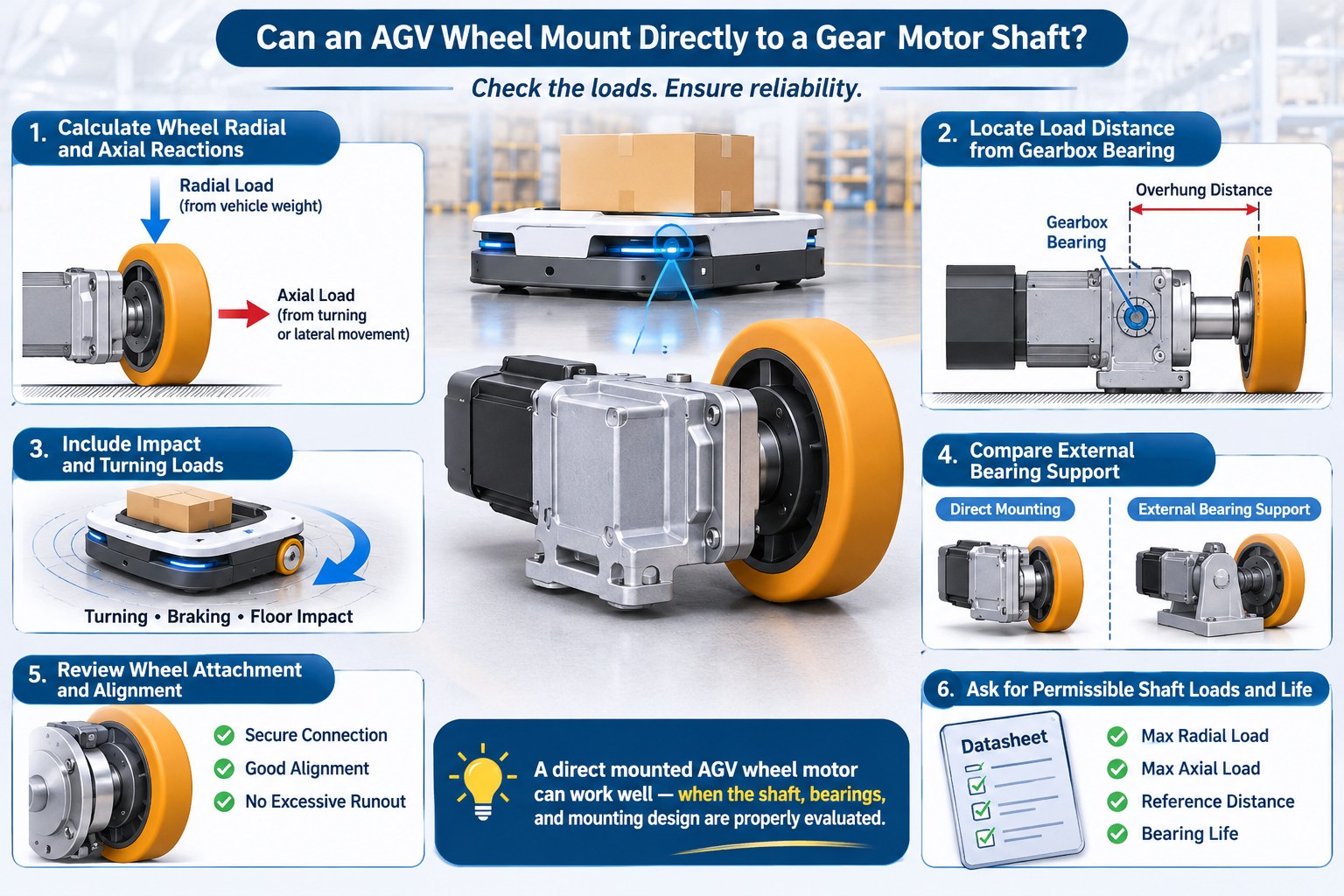
The challenge is that an AGV wheel does more than transmit driving torque. It also transfers vehicle weight, turning forces, and floor impacts to the gearbox output shaft. If these loads exceed the gearbox's mechanical limits, shaft bending, bearing wear, and premature failure may follow.
So, can an AGV wheel mount directly to a gear motor shaft? Yes, but only when the shaft, bearings, and mounting structure are designed for the actual loads. Here are six things engineers should check.
Think of an AGV wheel as more than a rotating component — it is also a load-transfer point between the vehicle and the ground.
Radial load acts perpendicular to the motor shaft, mainly resulting from vehicle weight and wheel-ground reactions. Axial load acts along the shaft, often appearing during turning, lateral movement, or uneven floor contact.
For example, when an AGV carries a heavy payload, the wheel transfers part of that weight through its hub to the gearbox output shaft. During a turn, additional lateral forces may increase the load on the shaft and bearings.
When calculating the AGV wheel bearing load on the motor shaft, engineers should consider both radial and axial reactions, rather than relying on rated output torque alone. A motor may deliver enough torque to move the vehicle but still lack the bearing capacity to support its wheel.
Here is a detail that is easy to overlook: the position of the wheel matters just as much as the force it carries.
When a wheel is mounted outside the gearbox housing, its load acts at a certain distance from the nearest supporting bearing. This distance creates a bending moment on the output shaft.
In simple terms, the farther the wheel load is from the bearing, the greater the bending effect. Even a moderate radial force can become a serious mechanical challenge when the shaft extension is too long.
This is known as an AGV motor overhung load. Engineers should check the wheel centerline, shaft extension, bearing position, and permissible overhung load before confirming direct mounting.
A useful rule: never evaluate an overhung load without checking the distance at which it acts.
AGVs do not always travel on perfectly smooth floors or move in straight lines. They accelerate, brake, turn, and occasionally pass over floor joints or small obstacles.
Each action can introduce dynamic loads beyond the normal static wheel load. Sharp turns may generate lateral forces, while sudden stops and floor impacts can create short-duration load peaks.
Ignoring these conditions is like designing a vehicle for a smooth laboratory floor and expecting it to perform perfectly in a real factory.
For reliable selection, evaluate:
Maximum vehicle and payload weight
Acceleration and braking forces
Turning radius and lateral forces
Floor conditions and possible impacts
Operating frequency and duty cycle
The gearbox should be selected according to the actual operating conditions, not just the average load.
Does every AGV wheel need to be supported directly by the gearbox? Not necessarily.
For compact, lightweight AGVs, direct wheel mounting can reduce installation space and simplify the drive structure, provided the gearbox is designed to handle the resulting loads.
For heavier vehicles or applications with significant overhung loads, an external bearing support may be a better solution. It transfers much of the wheel's radial force and bending moment to the AGV chassis, reducing the mechanical burden on the gearbox output shaft.
| Mounting Structure | Main Advantage | Consideration |
|---|---|---|
| Direct mounting | Compact, fewer components, simple assembly | Gearbox bearings must withstand wheel loads |
| External bearing support | Better support for heavy radial loads | More components and installation space |
The best solution depends on vehicle weight, wheel dimensions, available space, and operating conditions. A smaller drive system is not always a better drive system if it sacrifices bearing life.
Even a properly selected gearbox can encounter problems if the wheel is poorly installed.
The wheel hub and output shaft must have a reliable mechanical connection. Check the shaft diameter, keyway or spline, flange dimensions, fastening method, and torque transmission capacity.
Alignment is equally important. If the wheel is not concentric with the output shaft, rotation may introduce vibration and uneven bearing loads. Loose fasteners, shaft runout, or an uneven mounting surface can also accelerate wear.
In other words, a strong motor cannot compensate for a poor mechanical connection. Accurate machining, secure fastening, and proper alignment are essential for smooth and reliable AGV operation.
Before finalizing a direct-mounted AGV wheel motor, ask the motor supplier for more than rated power, speed, and torque.
The following mechanical data are particularly important:
Maximum permissible radial load at the specified shaft position
Maximum permissible axial load
Reference distance from the gearbox bearing
Output shaft dimensions and allowable bending moment
Bearing life under the expected load and operating cycle
One important detail: radial load ratings are meaningful only when their reference positions are known. The same force applied closer to or farther from the gearbox bearing can produce very different bending moments.
Also, remember that rated output torque and permissible shaft load are two different specifications. Both must meet the application requirements.
Can an AGV wheel mount directly to a gear motor shaft? Absolutely — when the gearbox output shaft and internal bearings are designed to support the wheel's mechanical loads.
For OEMs developing AGV and AMR drive systems, the key is to evaluate torque, radial load, axial load, overhung distance, and operating conditions together. If the wheel load exceeds the gearbox's limits, an external bearing support may be a more reliable solution.
Before choosing a direct mounted AGV wheel motor, share the vehicle weight, payload, wheel dimensions, mounting distance, speed, and duty cycle with your motor supplier. A little engineering work during the selection stage can prevent a much bigger maintenance problem later.
 BACK
As a “barometer” of China's foreign trade, the 139th Canton Fair (April 2026…
The 2nd Advanced Motor Materials Innovation Forum has officially opened, as indu…
Global Electric Motor Industry UpdateRecently, the global electric motor industr…
BG Motor Resumes Full Production – February 24, 2026BG Motor has officially resu…
Chinese New Year Holiday Notice (2026)Dear Valued Customers and Partners,To cele…
With the continuous upgrading of global manufacturing, the rapid growth of new e…