SEARCH
Motor noise is more than an acoustic issue—it can affect product quality, user comfort, and the overall perception of equipment reliability. In medical devices, service robots, household appliances, and automated equipment, excessive humming, vibration, or gear noise can become a major concern even when the motor delivers the required torque and speed.
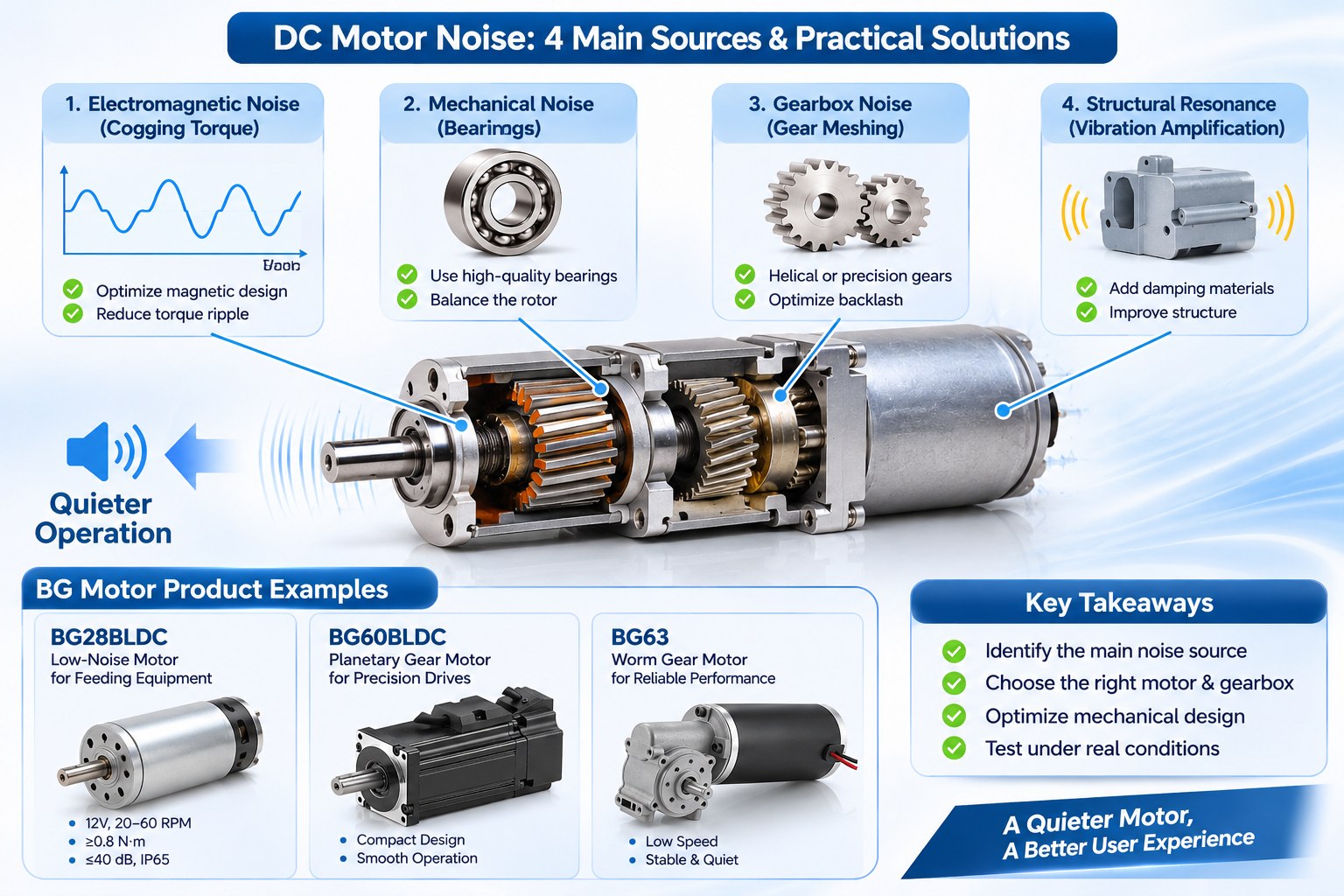
DC motor noise typically originates from electromagnetic forces, mechanical vibration, gear transmission, or resonance within the equipment structure. Identifying the dominant noise source is essential for choosing the right motor configuration and applying effective noise reduction measures.
Electromagnetic noise is generated by magnetic interaction between the rotor and stator, particularly when uneven air-gap fields or slot-pole interactions create periodic torque fluctuations. These fluctuations may produce humming or vibration, which becomes more noticeable at low speeds or when precise motion is required.
Noise reduction solutions:
Optimize slot-pole combinations and magnetic circuit design to reduce cogging torque.
Improve air-gap consistency and magnetic field distribution.
Select a motor with smoother torque output for low-speed, noise-sensitive applications.
For service robots, automatic feeders, and precision equipment, a smoother motor output helps prevent vibration from transferring to the driven mechanism. Brushless DC motors can be a suitable option where smoother operation and longer service life are priorities, although actual noise performance still depends on motor design, controller settings, and operating conditions.
Mechanical noise often comes from bearing friction, shaft misalignment, rotor imbalance, or improper assembly. Poor bearing quality or uneven rotor mass can create continuous vibration, while high-speed operation may amplify these problems and generate noticeable noise.
Noise reduction solutions:
Use high-quality bearings matched to the operating speed and load.
Perform rotor dynamic balancing to minimize vibration.
Improve shaft alignment, assembly accuracy, and mechanical tolerances.
Avoid excessive radial loading and unnecessary vibration transfer to the housing.
For compact medical equipment or household devices, mechanical stability is particularly important because the motor is often installed close to the user, with little space available for additional sound insulation.
In a DC geared motor, noise may not come from the motor itself but from the reduction mechanism. Gear tooth contact, backlash, machining accuracy, lubrication, and transmission alignment all influence the sound generated during operation. Under load, poor meshing conditions may produce clicking, rattling, or tonal noise.
Noise reduction solutions:
Consider helical gears to achieve smoother tooth engagement and reduce impact noise.
Use powder metallurgy gears where appropriate for the required load and cost.
Optimize gear accuracy, backlash, lubrication, and assembly alignment.
Select the appropriate gearbox type and reduction ratio instead of simply pursuing maximum torque.
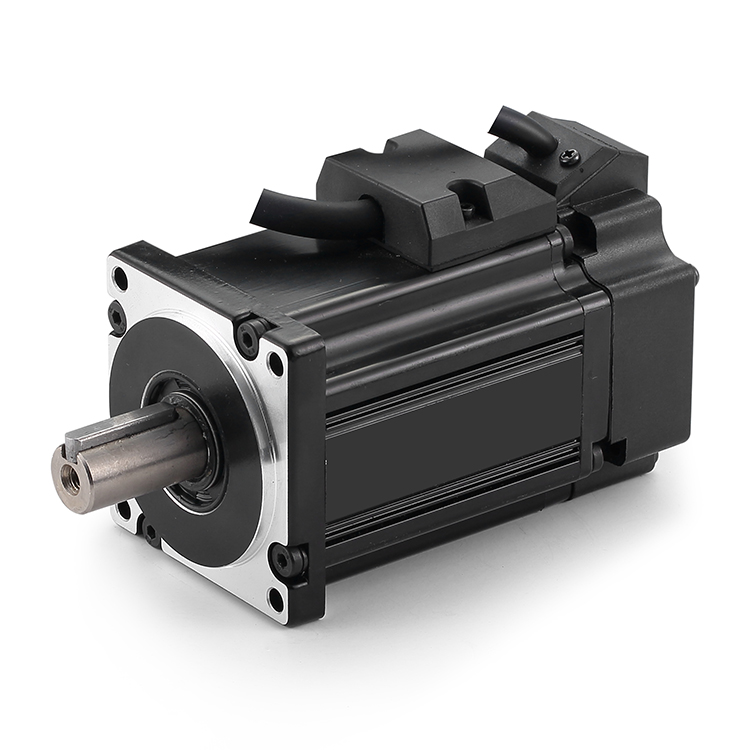
The BG60BLDC planetary geared motor is designed for applications requiring compact power transmission, speed reduction, and high output torque. Its geared structure makes it relevant to automated equipment, robotic mechanisms, and other applications where space and torque requirements must be balanced.
For noise-sensitive projects, engineers should evaluate the motor under the actual operating speed and load rather than relying only on unloaded noise measurements. Gearbox selection, mounting rigidity, transmission alignment, and controller configuration should all be reviewed together.
Product reference: BG60BLDC Planetary Gear Motor
Even when a motor operates smoothly, its vibration may transfer through mounting brackets, chassis panels, plastic housings, or connected mechanisms. If the vibration frequency coincides with a structural resonance frequency, the equipment may amplify the sound and produce a much louder result than the motor itself.
Noise reduction solutions:
Add vibration-isolation materials or damping pads at appropriate mounting interfaces.
Reinforce weak structural areas and optimize housing stiffness.
Avoid mounting arrangements that amplify vibration at the operating frequency.
Test the motor inside the complete equipment under realistic operating conditions.
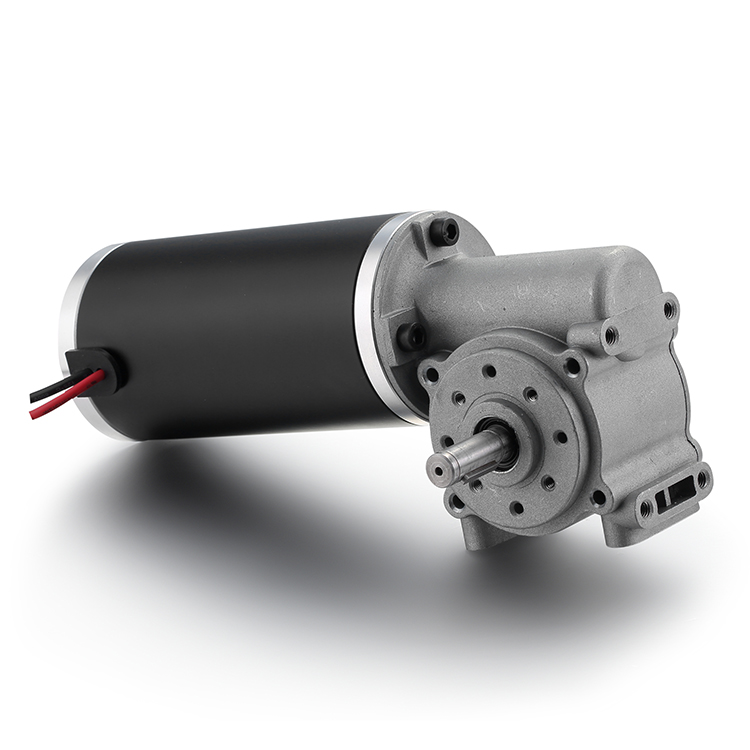
The BG63 worm geared motor is a compact drive solution used in applications such as automatic doors, desk lifts, and other low-speed drive mechanisms. Its worm transmission structure supports reduced-speed output and compact installation, but the final noise level still depends on gear contact, mounting conditions, load, lubrication, and structural resonance.
For automatic doors and lifting mechanisms, a quieter system should be developed by matching motor speed and torque to the load, minimizing unnecessary vibration, and isolating the transmission from structures that may amplify noise.
Product reference: BG63 Worm Gear Motors
Noise reduction is most effective when it is addressed during the initial motor selection and mechanical design stages rather than after the finished equipment has developed vibration problems.
In BG Motor's automatic feeder application, a BG28BLDC brushless geared motor was selected to drive the screw feeding mechanism, where stable low-speed output, accurate feeding, and quiet operation were important requirements.
Application configuration:
Motor: BG28BLDC series, 28 mm brushless geared motor
Voltage: 12 VDC
Output speed: 20–60 RPM, customized
Output torque: ≥0.8 N·m
Noise specification: ≤40 dB
Protection: IP65
The low-speed geared output supports smooth material delivery while the compact brushless drive meets the equipment's noise and environmental requirements. The project demonstrates how selecting an appropriate motor structure, output speed, and gearbox configuration can address noise concerns without sacrificing functional performance.
Application reference: BG Motor Automatic Feeder Motor Case
When developing a quiet motor-driven product, engineers should consider more than the motor's rated power or speed. The following factors can help reduce noise from the beginning of the project:
| Design Factor | Recommended Approach |
|---|---|
| Motor type | Select brushed or brushless structure according to noise, torque ripple, cost, and lifespan requirements |
| Gearbox | Evaluate gear type, tooth accuracy, backlash, lubrication, and load conditions |
| Mechanical assembly | Check bearing quality, shaft alignment, rotor balancing, and mounting rigidity |
| Operating conditions | Evaluate speed, load, acceleration, and duty cycle |
| Equipment structure | Reduce vibration transfer and avoid resonance |
| Testing | Measure noise under actual load and inside the complete product |
DC motor noise is usually the result of multiple factors rather than a single defective component. Electromagnetic torque fluctuations, mechanical imbalance, gearbox meshing, and structural resonance can all contribute to the final sound level of a product.
For OEMs developing medical equipment, service robots, household appliances, and automated mechanisms, the most effective approach is to identify the dominant noise source first, then optimize motor selection, gearbox structure, mounting design, and operating parameters together.
BG Motor offers brushed DC motors, BLDC motors, and geared motor configurations for customized applications. By defining the required speed, torque, installation space, noise target, and operating conditions early, engineers can work toward a drive solution that delivers reliable performance with better acoustic comfort.
 BACK
As a “barometer” of China's foreign trade, the 139th Canton Fair (April 2026…
The 2nd Advanced Motor Materials Innovation Forum has officially opened, as indu…
Global Electric Motor Industry UpdateRecently, the global electric motor industr…
BG Motor Resumes Full Production – February 24, 2026BG Motor has officially resu…
Chinese New Year Holiday Notice (2026)Dear Valued Customers and Partners,To cele…
With the continuous upgrading of global manufacturing, the rapid growth of new e…