SEARCH
As the FPV and UAV industries continue growing rapidly, drone pilots are paying more attention than ever to flight performance, throttle response, endurance, and aerial stability. While many beginners initially focus on cameras, flight controllers, or ESC systems, experienced pilots understand that the motor is actually the true heart of the drone. A properly selected motor directly determines how the aircraft accelerates, corners, hovers, carries payloads, and responds during aggressive maneuvers.
Whether building a lightweight 3-inch freestyle drone, a powerful 5-inch racing platform, or a long-range 7-inch cinematic UAV, choosing the correct motor requires much more than simply selecting the highest KV or largest stator size. The best drone motor is always the result of balanced system matching between frame size, propeller diameter, battery voltage, thrust requirements, and flight style.
At BGS Drone Motor Website, we specialize in high-performance outrunner brushless motors engineered for FPV racing, freestyle drones, long-range UAV systems, and industrial drone applications. By understanding the complete motor selection logic, pilots can build drones that not only fly faster, but also feel smoother, more stable, and significantly more efficient in the air.
Many FPV beginners mistakenly believe that drone speed mainly comes from powerful batteries or aggressive propellers. In reality, the motor acts as the central link connecting every part of the propulsion system together. If the motor is poorly matched to the aircraft, even expensive electronic components cannot compensate for the performance limitations.
An oversized motor may create unnecessary weight and poor throttle responsiveness, while a motor with excessively high KV can generate overheating, unstable current draw, and inefficient flight behavior. On the other hand, a properly optimized motor setup allows the drone to feel extremely precise and controllable, delivering stronger acceleration, smoother cornering, improved hovering stability, and longer flight time.
This is especially important in modern FPV flying, where pilots constantly switch between rapid throttle bursts, sharp directional changes, and low-throttle precision control during freestyle or cinematic maneuvers.
Choosing a drone motor should never begin with KV alone. Instead, the selection process follows a logical chain:
Frame Size → Propeller Size → Motor Size → Battery Voltage → KV Matching → Thrust Requirement
Every part of the system influences the next. Once pilots understand this relationship, selecting the correct FPV motor becomes far easier and more scientifically predictable.
The drone frame is usually the starting point for all motor selection decisions because it determines the maximum propeller size the aircraft can safely support.
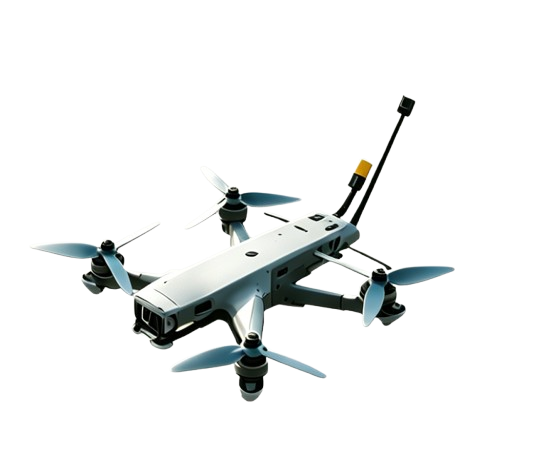
For example:
As frame size increases, the drone generally requires:
Smaller FPV drones, however, prioritize agility and rapid throttle response. This is why compact freestyle and racing builds often use lighter motors with very high KV values to maximize RPM and acceleration.
The frame therefore acts as the foundation of the entire propulsion system.
Propellers dramatically affect how a drone motor behaves under load. Many beginners underestimate how important propeller selection is when tuning flight characteristics.
Large propellers generate greater thrust because they move more air, but they also create significantly more resistance. This forces the motor to work harder and requires stronger torque output to maintain stable RPM.
Smaller propellers spin faster and feel more responsive, making them ideal for racing drones where rapid directional changes and instant throttle recovery are critical.
This explains why FPV racing drones often use lightweight high-pitch 5-inch propellers, while long-range drones prefer larger low-pitch propellers optimized for efficiency and smooth cruising behavior.
In many cases, changing propellers can completely transform how a drone feels in the air, even without changing the motor itself.
Drone motors are commonly identified using four-digit sizing systems such as 2207 or 2306.5.
For example:
The stator acts as the electromagnetic core of the motor, and its dimensions directly affect torque generation, heat dissipation, and overall power delivery.
Larger stators generally provide:
Smaller motors usually offer:
This is why 2207 motors dominate freestyle FPV builds, while larger 2806.5 motors are more common in long-range and cinematic drones carrying heavier payloads.
When discussing high-speed drone motors, KV rating becomes one of the most important specifications.
RPM=KV×Voltage
KV represents how many revolutions per minute the motor produces for every volt applied under no-load conditions.
Higher KV motors spin faster and deliver more aggressive throttle response, which is why they are extremely popular in FPV racing. However, higher RPM also increases current draw and heat generation, especially when paired with large propellers.
Lower KV motors spin slower but generate stronger torque and improved efficiency. These motors are more suitable for larger drones, long-range builds, and cinematic applications where stability and endurance matter more than raw acceleration.
The ideal KV therefore depends heavily on the drone’s intended purpose.
Battery voltage plays a major role in motor behavior and overall drone performance.
For years, 4S systems dominated FPV flying because they were affordable, beginner-friendly, and easier to tune. High-KV motors paired with 4S batteries still provide excellent performance for many freestyle and racing drones today.
However, modern FPV increasingly favors 6S setups because they provide several major advantages:
A typical 5-inch FPV drone might use:
Although 6S systems produce more power, they also require better ESC tuning and higher-quality components to manage the increased electrical stress.
Different drone categories require completely different motor setups.
3-inch drones are extremely agile and lightweight, making them ideal for:
indoor freestyle
These drones commonly use:
Most setups pair with 4S batteries and high KV ratings between 3000KV and 4500KV.
Because the propellers are small and lightweight, the motors can accelerate extremely quickly, creating sharp and highly responsive flight behavior.
The 5-inch category remains the global standard for FPV freestyle and racing.
This platform offers one of the best balances between:
Popular motor sizes include:
For 4S setups, pilots typically choose higher KV configurations around 2400KV–2700KV. Meanwhile, 6S builds commonly use lower KV motors between 1700KV–2100KV for smoother power delivery and stronger efficiency.
At BGS, our 2207 FPV motor platforms are specifically optimized for modern freestyle and racing applications, combining lightweight rotor structures with high-efficiency magnetic circuits to deliver fast throttle response and stable high-RPM performance.
7-inch drones prioritize endurance and efficiency rather than pure acceleration.
These aircraft are commonly used for:
Because larger propellers create more resistance, these drones require stronger torque-focused motors such as:
Most long-range systems pair with 6S batteries and lower KV ratings between 1200KV–1800KV to improve efficiency and reduce heat generation during extended flights.
One of the most overlooked aspects of motor selection is thrust calculation.
A drone should generally maintain at least a 2:1 thrust-to-weight ratio for stable flight.
Thrust Ratio=Drone WeightTotal Thrust
However, freestyle and racing drones often aim for much higher thrust ratios, sometimes reaching 4:1 or greater. This allows the drone to recover rapidly during dives, execute explosive punch-outs, and maintain aggressive maneuverability.
Pilots carrying action cameras or additional payloads must also account for extra weight when selecting motors and propellers.
Different flight styles require completely different motor characteristics.
Racing drones prioritize rapid acceleration, lightweight motors, and extremely fast throttle recovery.
Freestyle drones require smoother mid-throttle control and balanced torque for cinematic tricks and technical maneuvers.
Long-range drones focus more heavily on efficiency, stable cruising, and lower operating temperatures.
Cinematic FPV builds prioritize low vibration, smooth hovering behavior, and highly controllable throttle response for stable footage capture.
The “best motor” therefore depends entirely on how the drone is intended to fly.
Today, nearly all FPV and UAV systems use outrunner brushless DC motors because they offer the ideal balance between torque, efficiency, cooling performance, and weight.
Compared with brushed motors or inrunner designs, outrunner motors provide:
These advantages make them the perfect solution for both FPV racing and industrial UAV applications.
As a professional UAV motor manufacturer with more than 30 years of motor engineering experience, BGS focuses specifically on advanced outrunner propulsion systems for drones and FPV applications.
Our motors are engineered with:
high-efficiency magnetic structures
precision rotor balancing
optimized airflow cooling
durable CNC aluminum construction
high-temperature resistant magnets
customized KV solutions
Whether developing lightweight FPV racing motors or larger industrial UAV propulsion systems, BGS continues helping drone manufacturers and pilots achieve stronger thrust, smoother flight behavior, and more reliable long-term performance.
 BACK
BACK
As a “barometer” of China's foreign trade, the 139th Canton Fair (April 2026…
The 2nd Advanced Motor Materials Innovation Forum has officially opened, as indu…
Global Electric Motor Industry UpdateRecently, the global electric motor industr…
BG Motor Resumes Full Production – February 24, 2026BG Motor has officially resu…
Chinese New Year Holiday Notice (2026)Dear Valued Customers and Partners,To cele…
With the continuous upgrading of global manufacturing, the rapid growth of new e…