SEARCH
A motor may have enough power, yet the equipment still struggles to start, runs slower than expected, or becomes unusually hot after several hours of operation. In many cases, the problem is not the motor itself, but the mismatch between the motor and gearbox.
Gear ratio is one of the most important factors in gear motor selection. It determines how motor speed and torque are converted into usable output performance. Choosing the wrong ratio can lead to unnecessary energy consumption, excessive motor loading, and premature wear of mechanical components.
So, how do you find the right gear ratio for your equipment? The key is to balance output speed, torque requirements, transmission efficiency, and actual working conditions.
Think of a gearbox as a mechanical assistant. It trades speed for torque, allowing a relatively small motor to drive a heavier load at a controlled speed.
However, choosing a higher reduction ratio does not always mean better performance.
When the ratio is too small: The gearbox provides insufficient torque multiplication. The motor may need to work harder to drive the load, especially during startup or acceleration. This can increase current consumption, temperature rise, and long-term stress.
When the ratio is too large: The output speed may become too low for the equipment's operating requirements. Additional transmission losses, friction, and mechanical complexity may also reduce overall system efficiency.
The ideal gear ratio is not the highest or lowest available option. It is the ratio that allows the motor to operate comfortably while delivering the speed and torque the equipment actually needs.
One common mistake in gear motor selection is choosing a motor based only on its rated power. In practice, two machines with the same power requirements may need completely different gear ratios because their loads, movement speeds, and operating cycles are different.
Before selecting a gearbox, answer three practical questions:
What load does the equipment need to move?
Consider the weight of the load, friction, mechanical resistance, and any external forces. A conveyor carrying heavy materials, for example, needs more starting torque than an unloaded conveyor.
How fast does the equipment need to operate?
Define the required output speed based on the actual application. Automatic doors need controlled opening and closing speeds, while AGV drive systems must balance travel speed with sufficient traction.
How does the equipment operate?
Does it run continuously, start and stop frequently, or experience sudden changes in load? These conditions directly affect motor selection, gearbox durability, and thermal performance.
Once these requirements are clear, you can estimate the required output torque and speed instead of selecting a motor based on power alone.
After determining the required output speed, the next step is to match it with the motor's rated speed.
For example, suppose an industrial conveyor requires an output speed of 60 RPM, while the selected motor runs at 1,500 RPM. A reduction ratio of approximately 25:1 would be a reasonable starting point.
But speed is only half of the story.
The gearbox must also provide enough output torque to handle the actual load. Its transmission efficiency determines how much of the motor's torque reaches the output shaft.
When evaluating a gear motor, check the following:
Output torque: Is it sufficient for normal operation, startup, and acceleration?
Motor power: Can the motor handle the required mechanical workload without continuous overload?
Rated speed: Does the output speed match the equipment's operating cycle?
Thermal performance: Can the motor and gearbox operate safely under the expected duty cycle?
It is also important to distinguish between rated torque and peak torque. A motor may provide higher torque for a short period during startup, but this does not mean it can operate continuously at that level.
A properly matched gear motor should meet the required performance without relying on excessive overload capacity.
Different gearbox structures offer different advantages. Selecting the right one can improve not only transmission efficiency but also installation flexibility and long-term reliability.
Planetary Gear Motors – High Torque in a Compact Design
<text_placeholder />
Planetary gearboxes distribute the load across multiple planetary gears, providing high torque density, compact construction, and generally good transmission efficiency.
They are particularly suitable for applications where installation space is limited but strong output performance is required.
Typical applications include:
AGV and AMR drive systems
Industrial robots and automation equipment
Material handling machinery
Compact lifting and positioning systems
For equipment requiring frequent acceleration or high output torque, planetary gear motors are often a practical choice.
Worm Gear Motors – Flexible Installation and High Reduction Ratios
Worm gearboxes use a worm and worm wheel to achieve right-angle transmission, making them useful when the motor and output shaft need to be arranged at different angles.
Their compact right-angle layout and ability to provide high reduction ratios make them suitable for many industrial applications.
Typical applications include:
Automatic doors and gate systems
Conveyors and material handling equipment
Compact machinery
Equipment requiring right-angle drive arrangements
One important consideration is efficiency. Worm gearboxes rely on sliding contact, which generally produces more friction and heat than planetary gearboxes. Their efficiency varies with the reduction ratio, materials, lubrication, and operating conditions.
Some worm gear designs can offer self-locking characteristics, but this should always be verified for the specific gearbox rather than assumed.
Which One Should You Choose?
If high torque density and transmission efficiency are priorities, planetary gear motors are worth considering. If right-angle installation and high reduction ratios are more important, worm gear motors may be a better fit.
The best choice depends on the complete mechanical design, not simply the gearbox type.
The same motor and gearbox combination may perform very differently under different operating conditions. A good selection should reflect how the equipment actually works.
Frequent Start-Stop Applications
Automatic doors, AGVs, and robotic systems frequently accelerate, decelerate, and change direction. These movements create additional demands on motor torque and gearbox durability.
For these applications, consider:
Sufficient starting and acceleration torque
Load inertia and braking requirements
Motor temperature during repeated operation
Gearbox resistance to mechanical shock
A suitable reduction ratio helps the motor handle acceleration without unnecessary overload, while the gearbox must be capable of withstanding repeated mechanical stress.
Continuous-Duty Applications
Conveyors, production machinery, and industrial processing equipment may operate for several hours or even around the clock.
In these cases, transmission efficiency and thermal management become especially important. An unnecessarily high reduction ratio may increase transmission losses, while an undersized motor may experience continuous overload.
Prioritize stable output speed, suitable rated torque, effective heat dissipation, and gearbox lubrication.
Variable-Load Applications
Robotics, lifting equipment, and automated machinery often experience changing loads throughout their operating cycles.
Selecting a gear motor based only on average load can lead to insufficient torque during demanding operating stages. Instead, evaluate maximum working load, acceleration, and the frequency of load changes.
Even when the motor's rated power appears sufficient, several selection mistakes can reduce equipment performance.
| Common Mistake | Possible Result |
|---|---|
| Selecting a ratio based only on output speed | Insufficient starting torque |
| Choosing an oversized reduction ratio | Low output speed and unnecessary losses |
| Ignoring startup and acceleration loads | Motor overload or gearbox stress |
| Using a high-efficiency gearbox without checking load capacity | Insufficient mechanical durability |
| Ignoring operating temperature and duty cycle | Reduced motor and gearbox service life |
A reliable gear motor solution requires the motor, gearbox, and driven equipment to be evaluated as one complete system.
At BG Motor, gear motor selection starts with the customer's actual application requirements rather than a single power or speed specification.
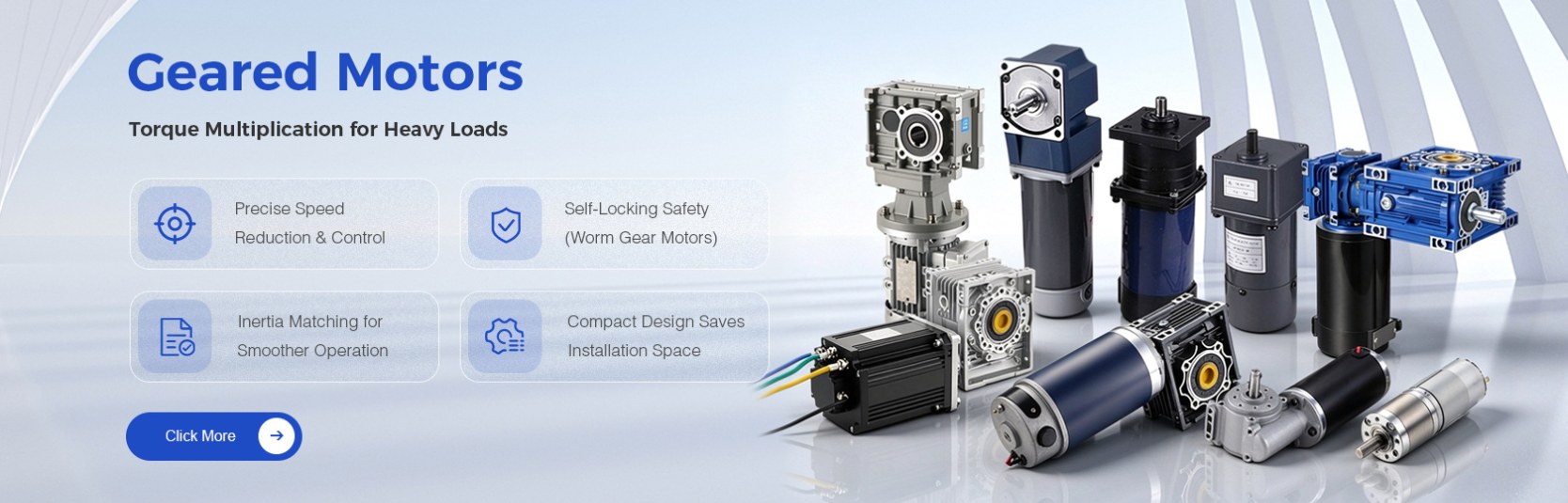
Our product range includes DC gear motors, BLDC gear motors, planetary gear motors, and worm gear motors for different industrial applications.
Depending on the equipment design, key parameters such as voltage, power, output speed, reduction ratio, torque, shaft configuration, and mounting dimensions can be considered together.
For example:
AGV and mobile robots: High-torque geared BLDC solutions for stable driving performance and frequent movement.
Automatic doors and gate systems: Compact DC gear motors designed around controlled output speed and reliable starting performance.
Industrial machinery: AC and DC gear motors with suitable reduction structures for continuous or intermittent operation.
By evaluating load characteristics, operating cycles, installation space, and performance targets, BG Motor can help OEM customers develop a motor and gearbox combination that better fits their equipment.
Choosing the right gear ratio is about more than increasing torque or reducing speed. It is about allowing the motor and gearbox to work together efficiently under real operating conditions.
A ratio that is too small may place unnecessary stress on the motor, while excessive reduction can limit output speed and increase transmission losses. By understanding the load, calculating the required output performance, and selecting the appropriate gearbox structure, equipment manufacturers can improve energy efficiency, reduce mechanical stress, and extend service life.
The best gear ratio is not the biggest one. It is the one that makes your entire drive system work smarter.
Contact BG Motor to explore a customized gear motor solution for your application.
 BACK
As Thanksgiving arrives, we would like to take a moment to express our heartfelt…
As a “barometer” of China's foreign trade, the 139th Canton Fair (April 2026…
The 2nd Advanced Motor Materials Innovation Forum has officially opened, as indu…
Global Electric Motor Industry UpdateRecently, the global electric motor industr…
BG Motor Resumes Full Production – February 24, 2026BG Motor has officially resu…
Chinese New Year Holiday Notice (2026)Dear Valued Customers and Partners,To cele…