SEARCH
For many years, the NEMA17 stepper motor has been the standard choice for desktop FDM 3D printers. It provides a good balance of size, torque, and positioning accuracy, making it suitable for a wide range of printing applications.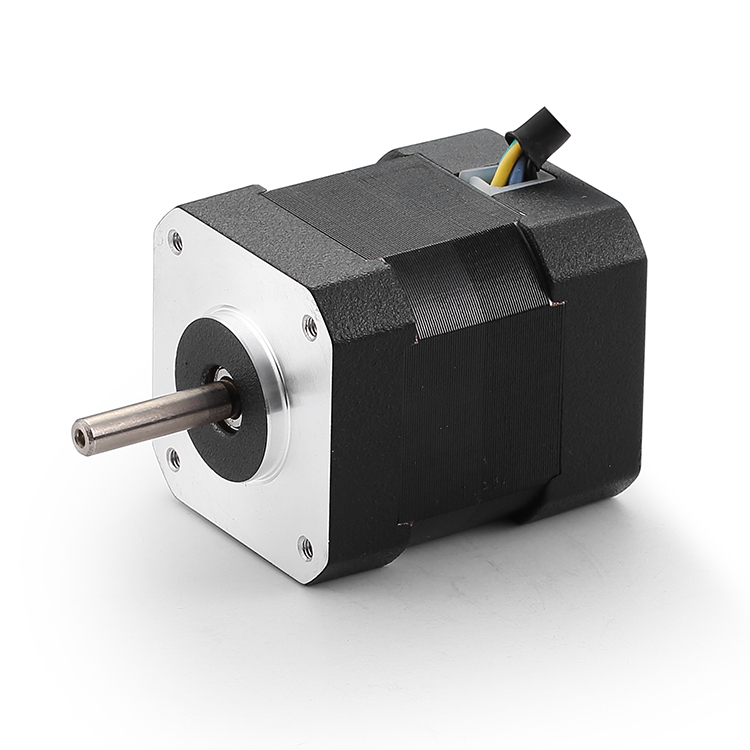
However, 3D printing technology has changed rapidly. Printing speeds that were once around 60–80 mm/s have increased to 300 mm/s or more on many modern machines. At the same time, technologies such as CoreXY motion systems, Input Shaping, and Pressure Advance have pushed printers to accelerate faster while maintaining high precision.
These improvements have created new demands on the entire motion system. Components that performed well in traditional printers may no longer deliver the same results under high-speed operating conditions. Among them, the stepper motor has become one of the most critical factors affecting motion stability and print quality.
A modern NEMA17 motor is no longer expected to simply move the print head from one position to another. It must accelerate quickly, maintain torque at higher speeds, minimize vibration, and repeat millions of precise movements throughout a print job.
As a result, engineers are changing the way they evaluate stepper motors. Instead of focusing only on holding torque, they now consider dynamic performance, inductance, vibration, and overall motion efficiency. These characteristics have become essential for achieving faster printing without sacrificing accuracy or reliability.
In the following sections, we explore how the latest generation of 3D printers is redefining the performance requirements of NEMA17 stepper motors and what engineers should consider when selecting a motor for high-speed applications.
When choosing a NEMA17 stepper motor, many buyers compare holding torque first. A higher holding torque often seems to indicate a stronger motor, making it an easy specification to compare.
However, holding torque only measures the motor's ability to resist movement while it is stationary. During a 3D printing process, the motor is rarely in this condition. Instead, it is constantly accelerating, slowing down, and changing direction as it follows thousands of motion commands.
This means a motor with the highest holding torque is not always the best choice for high-speed printing. If the motor cannot maintain enough torque at higher speeds, or if it responds too slowly during rapid acceleration, print quality can suffer through missed steps, vibration, or layer misalignment.
For this reason, experienced engineers evaluate more than just a single torque value. They pay closer attention to how the motor performs while it is moving, especially at higher speeds. Dynamic torque, response speed, and smooth operation have become more important than static holding torque alone.
This shift in focus reflects a simple reality: in modern 3D printing, motion performance matters more than standing still.
One challenge becomes more noticeable as printing speeds increase: the motor gradually loses torque at higher speeds.
This happens because a stepper motor needs time to build current inside its windings. At lower speeds, there is enough time for the current to reach the required level before the motor takes the next step. As the motor rotates faster, that available time becomes much shorter.
If the current cannot build up quickly enough, the motor cannot generate its full torque. As a result, acceleration becomes weaker, positioning becomes less stable, and the risk of missed steps increases.
This is why low inductance has become an important design feature for modern NEMA17 stepper motors. Lower inductance allows current to rise more quickly, helping the motor maintain usable torque even when operating at higher speeds.
For engineers designing high-speed 3D printers, this means selecting a motor based on holding torque alone is no longer enough. A motor with lower inductance and better high-speed torque retention often delivers smoother motion, more reliable positioning, and better overall print quality.
Simply put, as printing speed increases, the ability to maintain torque becomes more valuable than the ability to produce maximum torque while standing still.
Increasing printing speed does not automatically improve productivity. If the motion system becomes unstable, faster printing can actually reduce print quality.
One of the most common problems is vibration. During printing, the print head is constantly accelerating, stopping, and changing direction. Every movement creates small forces that travel through the belts, frame, and stepper motors. At low speeds these forces are usually insignificant, but at higher speeds they become much more noticeable.
If the motor cannot deliver smooth and consistent motion, these vibrations may leave visible marks on the printed surface. Common defects such as ringing or ghosting are often the result of vibration rather than poor extrusion.
This is why modern 3D printer manufacturers focus not only on speed, but also on motion stability. Factors such as rotor balance, manufacturing accuracy, and winding consistency all influence how smoothly a stepper motor operates.
A well-designed NEMA17 stepper motor helps reduce vibration, improves positioning accuracy, and allows the printer to maintain higher speeds without sacrificing surface finish. In other words, smooth motion is no longer just a comfort feature—it has become a key factor in achieving both speed and print quality.
When engineers discuss high-speed 3D printing, they often focus on motor torque and speed. However, motor weight is becoming another important factor in motion system design.
In many modern CoreXY and direct-drive printers, the stepper motor moves together with the print head. Every increase in motor weight adds more mass to the moving assembly. Although the difference may seem small, it becomes significant when the print head accelerates and changes direction thousands of times during a single print.
A heavier motor requires more force to start, stop, and reverse direction. This limits acceleration and places additional stress on belts, rails, and the printer frame. As a result, the machine may experience more vibration, longer settling times, and reduced printing efficiency.
For this reason, many equipment manufacturers no longer select the heaviest motor with the highest torque. Instead, they look for a better balance between weight, torque, and dynamic performance. A lighter motor with sufficient torque often allows the motion system to respond faster while maintaining stable print quality.
This is one reason why lightweight NEMA17 stepper motors are becoming increasingly popular in high-speed 3D printers. Reducing moving mass helps the entire motion system operate more efficiently, allowing higher acceleration without sacrificing accuracy or reliability.
In modern printer design, a motor should not only be powerful—it should also help the machine move faster, smoother, and more efficiently.
The role of the NEMA17 stepper motor is evolving alongside the rapid development of 3D printing technology.
In the past, selecting a motor was often as simple as comparing holding torque and installation size. Today, high-speed printing demands a much more comprehensive evaluation. Engineers must consider dynamic torque, inductance, vibration, moving mass, and overall motion stability to achieve higher printing speeds without compromising accuracy or surface quality.
This shift reflects a broader trend in motion control. Modern printers are no longer limited by a single component. Instead, overall performance depends on how well the motor, driver, controller, and mechanical structure work together as one system.
As printing speeds continue to increase and applications become more demanding, stepper motors will play an even greater role in determining productivity, reliability, and print quality. Choosing the right motor is no longer just a purchasing decision—it is an important part of motion system design.
 BACK
BACK
As a “barometer” of China's foreign trade, the 139th Canton Fair (April 2026…
The 2nd Advanced Motor Materials Innovation Forum has officially opened, as indu…
Global Electric Motor Industry UpdateRecently, the global electric motor industr…
BG Motor Resumes Full Production – February 24, 2026BG Motor has officially resu…
Chinese New Year Holiday Notice (2026)Dear Valued Customers and Partners,To cele…
With the continuous upgrading of global manufacturing, the rapid growth of new e…