SEARCH
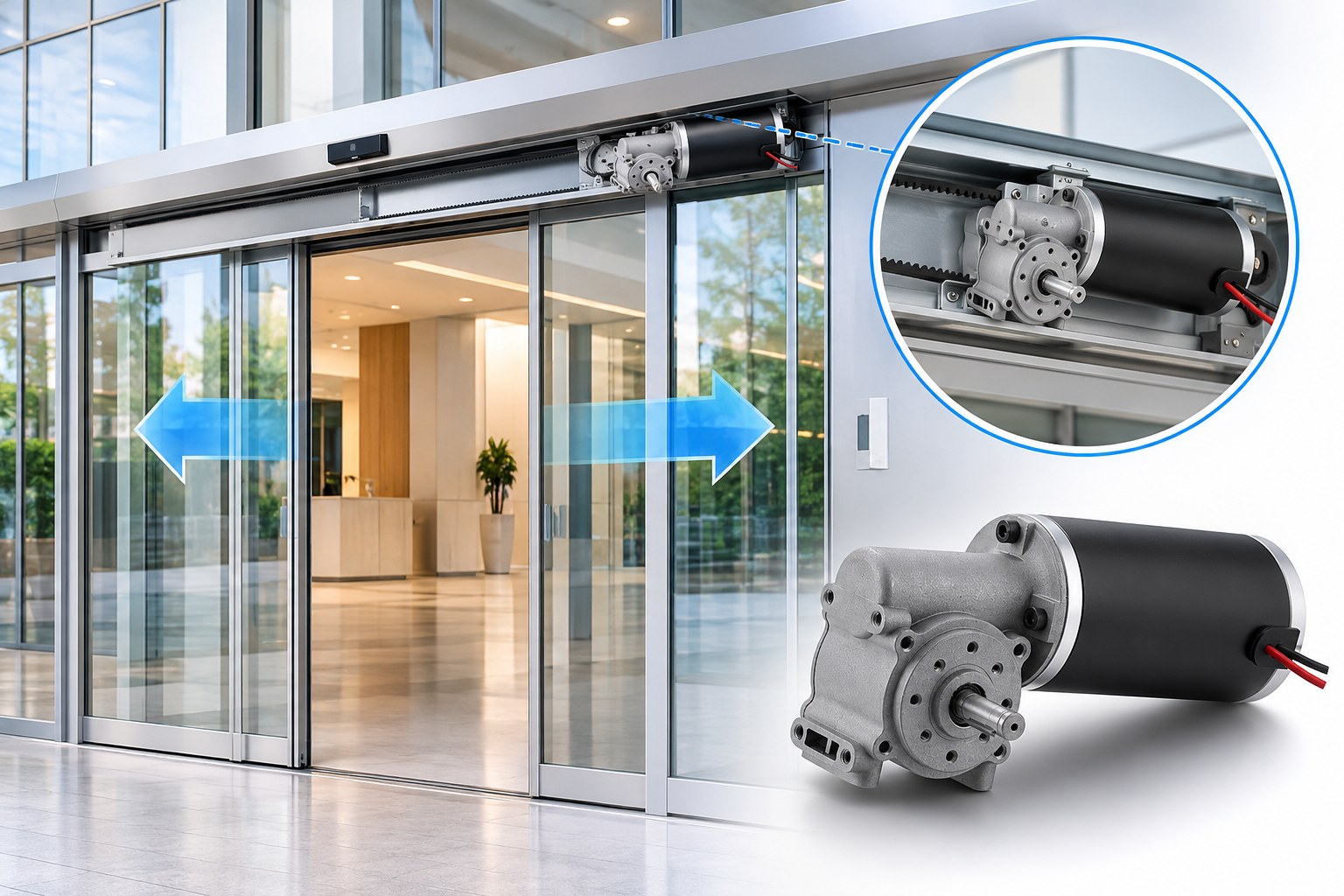
An automatic sliding door may look simple, but its drive system needs to do more than move a door panel from one side to another. It must start smoothly, maintain a stable travel speed, handle changing friction, and operate reliably through thousands of opening and closing cycles.
Choosing a gear motor based only on door weight or rated power can lead to slow movement, difficult starting, excessive noise, or premature gearbox wear. Proper automatic sliding door motor sizing requires a closer look at the mechanical load, pulley system, operating conditions, and control strategy.
Here are six important steps for selecting a suitable sliding door drive motor.
Start with the total moving mass of the door system, including the door panels, mounting brackets, and other components moving along the track. For double sliding doors, consider the combined moving mass and how the load is distributed between the panels.
Next, evaluate the resistance along the travel path. Roller friction, guide alignment, sealing components, and installation tolerances can all affect the force required to move the door.
Travel speed is another important factor. A lightweight door operating at high speed may require a different motor configuration from a heavier door moving slowly. Acceleration and deceleration requirements also influence the drive system.
Before beginning automatic door gear motor sizing, establish these basic parameters:
Total moving door mass
Required opening and closing speed
Travel distance and acceleration time
Roller and guide friction
Expected operating environment
Accurate input data makes motor selection much more reliable than simply choosing a higher-power motor.
A gear motor must overcome the initial resistance when the door starts moving, not just maintain movement after reaching its operating speed.
In a belt-driven sliding door, the motor transfers torque through a pulley to generate linear pulling force. The required pulley torque depends on the resistance force, pulley radius, and transmission efficiency.
A basic relationship is:
Pulley Torque = Required Linear Force × Pulley Radius
The actual motor output torque must also account for transmission losses and the acceleration required during startup.
Loaded starting conditions deserve particular attention. Door rollers may experience greater resistance after long periods of inactivity, while slight misalignment or mechanical wear can increase the force needed to initiate movement.
When performing sliding door drive motor selection, check both starting torque and running torque. A motor that maintains the required speed under normal conditions may still struggle when starting a fully loaded door.
Automatic sliding doors operate in environments where dust, moisture, and small debris can gradually accumulate along the track.
Even a small increase in rolling resistance can affect starting performance, especially when the door is already operating close to the motor's torque limit.
Consider several practical conditions:
Dust and debris accumulating on the guide rail
Roller wear or reduced lubrication
Increased resistance after long idle periods
Door misalignment caused by installation or structural movement
Repeated stopping and restarting during daily operation
A reliable drive system should be evaluated under realistic operating conditions rather than on a clean, newly installed track alone.
For OEMs, it is worth testing the motor and gearbox with representative door loads and controlled increases in mechanical resistance. This helps identify insufficient starting torque before the product enters regular operation.
The gear motor is only one part of an automatic sliding door system. Its performance also depends on the controller, sensors, and drive configuration.
Different applications may use infrared sensors, microwave motion sensors, presence detection, or access-control signals to initiate door movement. The control system determines when the motor starts, accelerates, slows down, and stops.
The motor and controller should be matched according to the required operating behavior:
| Drive Requirement | Selection Consideration |
|---|---|
| Smooth startup | Suitable acceleration control and starting torque |
| Stable travel speed | Appropriate motor speed and reduction ratio |
| Controlled stopping | Deceleration and braking strategy |
| Frequent opening cycles | Suitable motor duty rating and thermal performance |
| Position control | Compatible sensors, controller, and feedback system |
For applications requiring precise positioning or frequent speed adjustments, a controlled BLDC drive may be worth evaluating. Other applications may use different DC or geared motor configurations depending on cost, control requirements, and operating frequency.
The key is to select the motor as part of the complete drive system rather than treating it as an isolated component.
An automatic door in a busy shopping center may open hundreds or thousands of times per day, while a door in a small office may operate much less frequently. The same motor specification will not necessarily suit both applications.
Define the expected opening cycles, operating duration, rest periods, and ambient temperature. These factors influence motor heating, gearbox wear, and service life.
Noise is another important consideration. Gearbox design, reduction ratio, bearing quality, mounting stiffness, and transmission alignment can all affect operating noise. For hospitals, hotels, and office buildings, quiet movement may be just as important as speed.
Power-off behavior also needs to be defined before choosing the drive configuration. Consider whether the door should remain in position, allow manual movement, release a brake, or respond to a backup power supply.
The motor, gearbox, brake, controller, and mechanical transmission should be evaluated together to ensure the door behaves as intended when normal power is interrupted.
Motor sizing and door safety are related, but they are not the same engineering task.
A gear motor with sufficient torque does not automatically make an automatic sliding door safe. The complete door system must be evaluated for obstruction detection, opening and closing forces, emergency operation, sensor response, and failure behavior.
OEMs should validate the finished door assembly according to the applicable regional standards and installation requirements. This includes testing the interaction between the motor, controller, sensors, mechanical structure, and safety devices.
The motor supplier can provide technical information such as rated torque, speed, voltage, duty rating, shaft configuration, and braking options. However, final safety validation remains the responsibility of the door system manufacturer.
Selecting a gear motor for an automatic sliding door involves more than matching motor power to door weight. Starting resistance, pulley radius, travel speed, rail conditions, operating cycles, and control requirements all influence the final configuration.
For OEMs, a well-matched drive system should provide sufficient starting torque, stable movement, acceptable noise, and reliable operation throughout its expected service life.
BG Motor provides customized DC motor and gear motor solutions for OEM equipment. By sharing your door mass, pulley dimensions, required speed, operating frequency, and installation constraints, you can work with the motor supplier to identify a suitable drive configuration.
Explore our Gear Motors for Automatic Door OEMs or learn more about our Worm Gear Motors for OEM Equipment.
For customized motor and gearbox configurations, visit Custom Electric Motors and Gear Motors for OEMs.
You can also review our automatic door motor application case to learn more about motor applications in automatic door systems.
 BACK
As a “barometer” of China's foreign trade, the 139th Canton Fair (April 2026…
The 2nd Advanced Motor Materials Innovation Forum has officially opened, as indu…
Global Electric Motor Industry UpdateRecently, the global electric motor industr…
BG Motor Resumes Full Production – February 24, 2026BG Motor has officially resu…
Chinese New Year Holiday Notice (2026)Dear Valued Customers and Partners,To cele…
With the continuous upgrading of global manufacturing, the rapid growth of new e…